
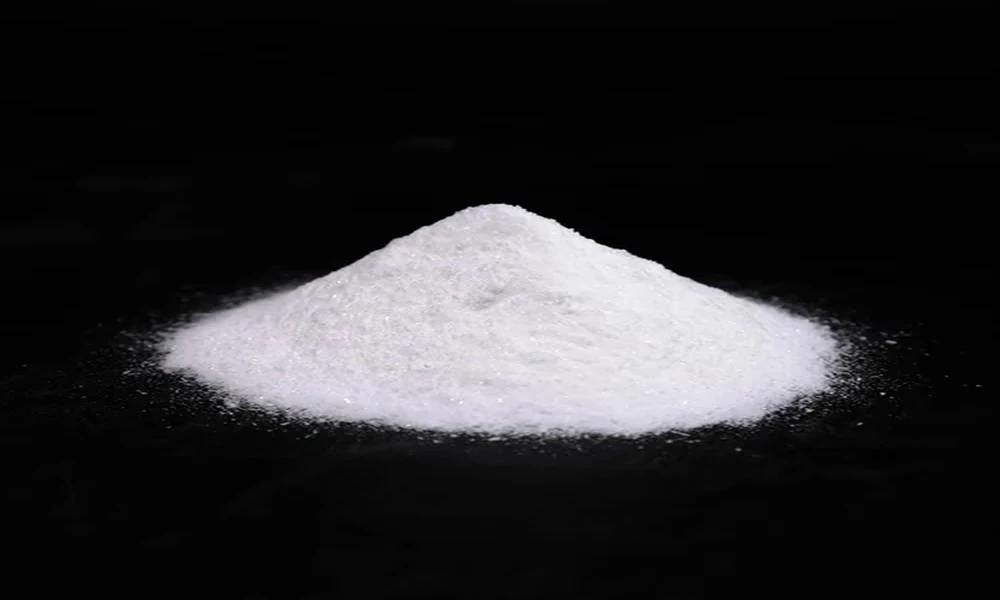
Potassium dihydrogen phosphate is a versatile inorganic salt whose applications span analytical chemistry, buffer preparation, agriculture, food technology, and pharmaceutical manufacturing. As one of the most widely used phosphate salts in laboratory and industrial chemistry, understanding the compound’s chemical properties, purity grades, and the sourcing considerations for laboratory and industrial applications helps procurement teams and laboratory managers make confident purchasing decisions.
What is potassium dihydrogen phosphate?
Potassium dihydrogen phosphate (KH2PO4, CAS no 7778 77 0, molecular weight 136.09 g/mol) is the monobasic potassium salt of phosphoric acid. It is also known as potassium monophosphate, potassium dihydrogen orthophosphate monobasic, monopotassium phosphate (MKP), and by its CAS registry number 7778 77 0. In its pure form it is a white crystalline powder that is freely soluble in water, producing a mildly acidic solution with a pH of approximately 4.5 at a 1% w/v concentration.
The compound’s key chemical properties:
- Molecular formula: KH2PO4
- CAS number: 7778 77 0 (also written as 7778-77-0)
- Molar mass: 136.09 g/mol
- Appearance: white crystalline powder or granules
- Solubility: approximately 25 g/100 mL water at 20 degrees Celsius, increasing with temperature
- pH (1% solution): approximately 4.5
- Melting point: 252.6 degrees Celsius
What are the main applications of potassium phosphate monobasic?
Potassium phosphate monobasic is used across several distinct application areas whose purity and specification requirements differ significantly:
- Buffer preparation: potassium monophosphate is one of the two components of the potassium phosphate buffer system, prepared in combination with dipotassium hydrogen phosphate (K2HPO4) to produce buffers across the pH range 5.8 to 8.0. Phosphate buffers are among the most widely used in biochemistry, molecular biology, and HPLC mobile phase preparation because of the buffer’s stability, UV transparency, and compatibility with biological systems
- HPLC mobile phase: analytical grade potassium dihydrogen phosphate dissolved in HPLC-grade water is a standard component of the aqueous mobile phase in reversed-phase and ion-pair HPLC methods for the analysis of polar compounds, biomolecules, and pharmaceuticals where the buffer controls the ionisation state of the analyte and the mobile phase pH
- Fertiliser: agricultural grade MKP is used as a high-analysis, chloride-free soluble fertiliser providing both phosphorus and potassium in a single product. MKP is particularly valued in fertigation systems and foliar application where the absence of chloride is important for sensitive crops
- Food additive: food grade potassium dihydrogen orthophosphate monobasic is used as an acidity regulator, emulsifying salt, and leavening agent in food processing applications including baking powders, processed cheeses, and beverages. The E-number designation is E340(i)
- Pharmaceutical manufacturing: pharmaceutical grade MKP serves as a buffering agent and pH regulator in parenteral formulations, ophthalmic preparations, and topical products where precise pH control is required
What purity grades are available for potassium dihydrogen phosphate?
Potassium dihydrogen phosphate is commercially available across several purity grades whose specification reflects the intended application:
- For Analysis / ACS: reagent grade meeting the specifications of the American Chemical Society (ACS) or the European Pharmacopoeia for analytical use. Purity typically 99.0% or above with controlled limits on heavy metals, chloride, sulphate, and other specified impurities
- USP / BP / Ph. Eur.: pharmacopoeial grades meeting the requirements of the United States Pharmacopoeia, British Pharmacopoeia, or European Pharmacopoeia for pharmaceutical manufacturing applications
- Food grade: meeting the specifications of the Food Chemicals Codex (FCC) or equivalent national food additive standards for use as a food additive or food processing ingredient
- Technical / fertiliser grade: lower purity grades suitable for agricultural and industrial applications where the tight impurity control of analytical or pharmaceutical grades is not required
What should laboratories consider when sourcing potassium dihydrogen phosphate?
For laboratory applications, the most important sourcing considerations for potassium monophosphate and related lab chemicals are the purity grade documentation, the batch certificate of analysis, the packaging integrity, and the supplier’s cold chain and humidity control during storage and transit. Analytical methods that depend on the precise pH of a phosphate buffer are sensitive to purity variations and impurity profiles that sub-specification material can introduce, making the certificate of analysis the primary quality assurance document rather than a formality.
Lab Chemicals is a supplier of potassium dihydrogen phosphate, potassium monophosphate, and a comprehensive range of analytical and laboratory chemicals including lab chemicals suppliers in India network products from leading manufacturers. Lab Chemicals’ product range covers For Analysis, ACS, USP, and other pharmacopoeial grades with the batch certificates of analysis, MSDS documentation, and the supply reliability that laboratory and pharmaceutical procurement requires.
How is potassium dihydrogen phosphate used in buffer preparation?
Buffer preparation is one of the most common laboratory uses of potassium dihydrogen phosphate, and the accuracy of the buffer’s pH is directly dependent on the purity of the reagents used. The potassium phosphate buffer system combines potassium monophosphate (KH2PO4) as the acidic component with dipotassium hydrogen phosphate (K2HPO4) as the basic component, with the ratio of the two salts determining the buffer pH across the range of approximately 5.8 to 8.0. Standard buffer tables from the National Institute of Standards and Technology (NIST) or the pharmacopoeias provide the mixing ratios for defined pH values at specified temperatures. For HPLC applications, the buffer is typically prepared by dissolving potassium dihydrogen orthophosphate monobasic in HPLC-grade water to the required concentration and adjusting pH with orthophosphoric acid or dipotassium hydrogen phosphate before filtering through a 0.22-micrometre membrane. The use of For Analysis or ACS grade potassium phosphate monobasic ensures that the buffer’s pH is accurate and reproducible and that UV-absorbing impurities do not interfere with HPLC detection at low wavelengths.

Comments are closed.