
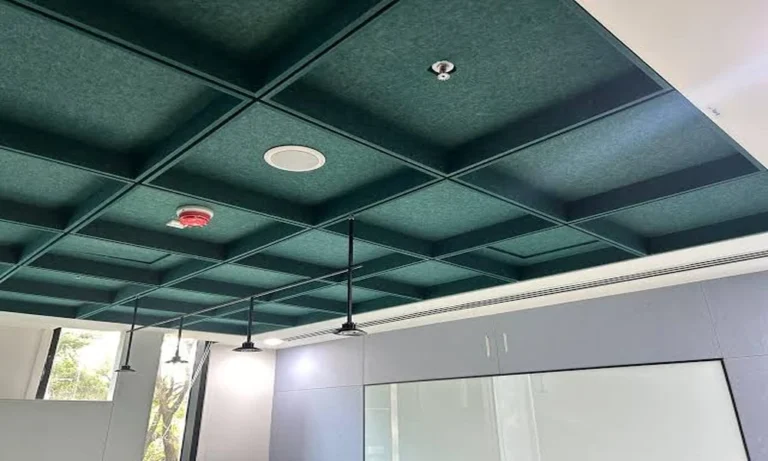
Choosing ceiling panels sounds straightforward at first. You pick a design you like, install it, and expect the space to feel better. But once you start looking into it, the options quickly become overwhelming. Different materials, shapes, sizes, and installation methods all promise similar results.
The truth is, not all acoustic ceiling panels work the same way in every space. What performs well in an office might not be the best fit for a home. What looks good in a café might not deliver the acoustic control needed in a meeting room.
Instead of focusing only on how panels look, it helps to understand what your space actually needs.
Start with how the space is used.
Before choosing any ceiling panel, think about what happens in the room on a daily basis.
- Is it a workspace where people need to concentrate?
- A meeting room where clear communication matters?
- A living area where multiple activities happen at once?
- Or a restaurant where conversations and background activity overlap?
Different uses create different sound patterns. A busy office needs panels that reduce the spread of conversations. A meeting room needs sound panels that improve clarity. A home may need something more balanced.
When you understand how the space is used, it becomes easier to narrow down what type of panel will actually work.
Pay attention to the size and shape of the room.
Room dimensions play a big role in acoustic performance.
Larger rooms or spaces with high ceilings tend to have more sound reflection simply because there’s more space for sound to travel. In these cases, ceiling panels become especially important.
Smaller rooms may not need as many panels, but placement still matters. Even in compact spaces, hard surfaces can cause sound to bounce around more than expected.
The shape of the room also matters. Long, narrow spaces can carry sound further, while square rooms may create more concentrated reflections. Your panel choice should take these factors into account.
Understand the difference between panel types.
Not all ceiling panels are designed the same way, and the material makes a difference.
Fabric-wrapped panels are one of the most common choices. They offer good sound absorption and are suitable for offices, meeting rooms, and homes.
Mineral fibre panels are often used in commercial ceiling systems. They provide consistent performance and are commonly found in offices and institutional spaces.
Foam panels are typically used in more specialised environments like studios, where more controlled acoustic treatment is required.
Then there are decorative acoustic panels, which combine performance with design. These are often used in hospitality or modern interiors where appearance matters just as much as function.
Choosing the right type depends on both performance needs and the overall look you’re aiming for.
Think about coverage, not just the panel itself.
One of the biggest mistakes people make is focusing too much on the panel and not enough on coverage.
A single high-quality panel won’t do much if it’s placed in the wrong spot or if there aren’t enough panels to treat the space effectively.
It’s better to think in terms of coverage area. How much of the ceiling needs to be treated to manage sound properly?
In many cases, partial coverage is enough, especially when panels are placed above key activity zones like desks, meeting tables, or seating areas. But the distribution needs to be intentional.
Consider ceiling height and installation style
The way panels are installed can change how effective they are.
In standard ceiling heights, direct-mounted panels work well and keep the design clean.
In higher ceilings, suspended panels or baffles are often more effective. These hang below the ceiling and intercept sound before it has a chance to reflect widely across the room.
Cloud panels, which are suspended horizontally, are also a popular option for larger spaces. They help control sound without covering the entire ceiling.
Choosing the right installation style ensures the panels are positioned where they can actually make an impact.
Don’t ignore the rest of the room.
Ceiling panels are important, but they’re only part of the overall acoustic picture.
If the room has a lot of hard surfaces like glass walls, tiled floors, or bare concrete, sound will still reflect from those areas.
In some cases, adding wall panels or soft furnishings can improve results significantly. It’s about creating balance rather than relying on one solution.
A well-treated space usually combines ceiling treatment with other elements to manage sound effectively.
Balance performance with design.
Modern ceiling panels come in a wide range of styles, so you don’t have to sacrifice aesthetics.
Some panels are designed to blend seamlessly into the ceiling, making them almost invisible. Others are meant to stand out, adding texture or visual interest to the space.
The key is to find a balance. Panels should enhance the space visually while still delivering the performance you need.
Choosing purely based on appearance can lead to disappointing results, so it’s worth considering both aspects together.
Start simple and adjust if needed
You don’t need to get everything perfect from the start.
In many cases, it’s better to begin with a smaller number of panels in key areas and see how the space responds. From there, you can add more if needed or adjust placement.
Acoustic improvement is often a process of fine-tuning rather than a one-time decision.
Signs you’ve chosen the right panels.
Once installed, there are a few simple indicators that your ceiling panels are working well:
- Conversations feel clearer and more natural
- Sound doesn’t linger as long after speaking
- The space feels more balanced during busy periods
- Noise doesn’t spread as aggressively across the room
These changes may feel subtle at first, but they make a big difference over time.
Final Thoughts
Choosing ceiling panels isn’t just about picking a product. It’s about understanding your space and how sound behaves within it.
When you match the right type of panel with the right placement and coverage, the results become much more noticeable. The space feels easier to use, more comfortable to spend time in, and better suited to its purpose.
It’s a simple upgrade on the surface, but when done properly, it can completely change how a room feels day to day.